
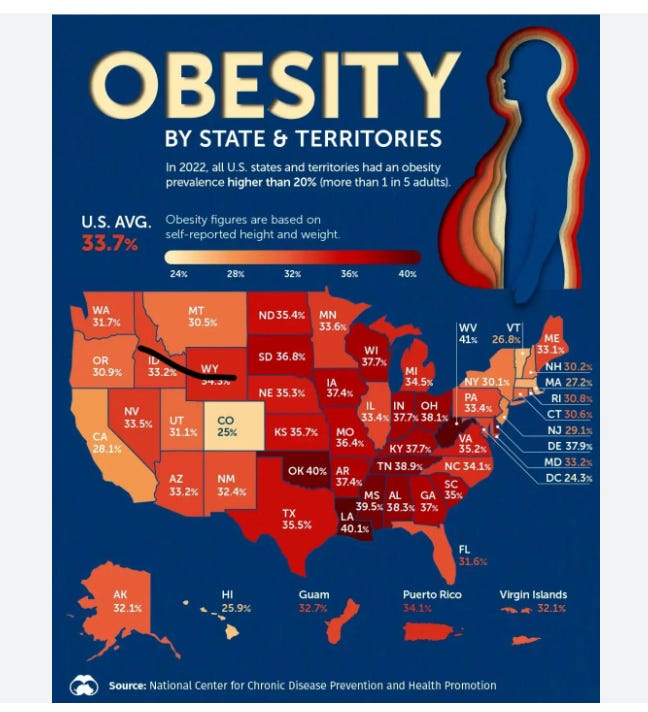
I use a couple of chapters from Julie Guthman’s book, Weighing In, in my International Political Economy class. The chapters critiques (neo)liberal understandings of and responses to obesity. One of Guthman’s many useful points are that obesity is a structural problem and not reducible to poor individual decision making.
Or, put it this way: Is obesity a serious problem in places like West Virginia because people decide to buy Mountain Dew or is because resident live in food deserts populated by gas stations that only sell nutrition free calories, like Doritos, Slim Jims, and soda pop?
A few weeks ago I read about a major study published recently in PNAS, which tags itself as “one of the world's most-cited and comprehensive multidisciplinary scientific journals.” The research upended conventional wisdom about obesity, according to The Washington Post. The research, involving over 4,000 people across 34 countries, found that Americans burn roughly the same number of calories daily as hunter-gatherers in Tanzania.
The implication, the article suggests, is clear: "We are, to be blunt, eating too much and probably eating too much of the wrong foods."
This conclusion—that diet, not inactivity, drives obesity—might seem novel. But the study's reframing reveals how dominant political-economic conceptualizations of obesity obscures the structural forces that actually shape bodies and health.
By shifting blame from individual laziness to individual dietary choices, the study perpetuates what Julie Guthman calls the "individualization" of a fundamentally social problem.
Nowhere is this misdirection more evident than in rural America, where obesity rates are highest and the structural causes most visible. West Virginia leads the nation in obesity, with 40.6% of adults classified as obese. Kentucky and Tennessee follow close behind.
These are not coincidentally the heart of Appalachia—a region where over a century of corporate extraction has systematically destroyed local food systems, poisoned environments, and abandoned communities that lack sustained federal investment.
The PNAS study's finding that energy expenditure remains relatively constant across cultures supports what lead author Herman Pontzer calls the "constrained total energy expenditure model.” This theory suggests our bodies maintain calorie burn within a narrow range, regardless of activity level. If we exercise more, our bodies compensate by reducing other metabolic processes.
This insight could have profound implications for understanding metabolism and health.
However, the way the research is being framed, works to reinforce a familiar narrative: obesity results from personal food choices and not structural situations residents find themselves living in.
The study's authors conclude that "increased energy intake has been roughly 10 times more important than declining total energy expenditure in driving the modern obesity crisis." The solution, they argue, is focusing on diet, especially "ultra-processed foods."
This framing exemplifies what Guthman identifies as the core problem with obesity discourse. It locates responsibility within individuals rather than examining the systems that shape food environments, which is fundamentally a conceptualization of political-economy rooted in liberal theory.
The study may challenge the "calories out" side of the equation, but it doubles down on "calories in" as a matter of personal responsibility and not structural conditions.
Consider what this narrative obscures in Appalachia. The region that now leads the nation in obesity rates was once characterized by diverse agriculture, subsistence farming, and rich food traditions. Families grew vegetables, preserved foods seasonally, hunted and fished, and maintained local food networks that provided both nutrition and economic stability.
This food system didn't disappear naturally—it was systematically destroyed.
Beginning in the late 19th century, coal companies consolidated land ownership, displaced agricultural communities, and created company towns dependent on external supply chains. The promise of industrial wages drew people away from farming, while company stores replaced local food networks with processed goods shipped from distant suppliers.
When mining jobs disappeared in the 1970s and 1980s, communities were left with neither industrial employment nor the agricultural infrastructure that had once sustained them.
Into this vacuum stepped corporations like Dollar General, which has explicitly targeted rural communities with limited retail options. The company now operates over 17,000 locations nationwide, becoming the primary food retailer in many Appalachian communities while offering primarily processed foods with long shelf lives.
This transformation represents what food studies scholars call "food apartheid"—the systematic creation of environments where healthy food is scarce and expensive while processed food is ubiquitous and cheap.
When the PNAS study finds correlations between "ultra-processed foods" and higher body fat, it's describing not individual dietary failures but the predictable result of corporate strategies and policy decisions that create the conditions in which West Virginians and other rural Americans live.
The focus on dietary choices also ignores the environmental dimensions of health in Appalachia.
Decades of mountaintop removal, chemical processing, and industrial pollution have created what environmental justice scholars call "sacrifice zones"—areas where corporate profits are prioritized over human health. The case of C-8 contamination in West Virginia illustrates this dynamic. DuPont knowingly released perfluorooctanoic acid into water supplies for decades, exposing residents to chemicals linked not just to cancer but to metabolic disorders and obesity.
Similar patterns of contamination exist throughout the region—coal ash ponds, fracking chemicals, industrial solvents—creating what medical anthropologists call "syndemic" conditions where multiple health problems compound each other.
Recent research suggests that certain chemicals, known as obesogens, may directly affect metabolism and weight regulation, which is another way of saying that corporate pollution creates environmental conditions where nearby residents are more likely to be fat.
What appears as individual dietary failure may partly result from involuntary chemical exposure—a possibility entirely absent from the PNAS study's framework.
The PNAS research exemplifies what Guthman calls the "molecular turn" in obesity studies—the tendency to reduce complex social phenomena to biological mechanisms. By focusing on energy expenditure and metabolic rates, the study treats bodies as closed systems responding to caloric inputs rather than as social beings shaped by historical, economic, and environmental forces.
We’re more like sponges soaking up the environment and less like unitary decision makers isolated from their surroundings.
This reductionist approach serves political and economic ideological functions.
It makes obesity appear as a technical problem with technical solutions rather than a social problem requiring political action. The study's conclusion that "public health efforts need to focus on diet" suggests that better nutrition education and individual behavior change can solve what is fundamentally a structural problem – like how markets distribute grocery stores and fresh vegetables.
The research also reflects what Guthman identifies as the "pathologization" of body diversity.
By using hunter-gatherer societies as implicit norms, the study treats higher body weights as inherently pathological rather than examining how different environments and social systems shape bodies in different ways. This framing reinforces the assumption that obesity is necessarily unhealthy and requires intervention.
Who benefits from framing obesity as a problem of individual dietary choices? It ain’t the people of WVa, but DG share holders and executive officers certainly benefit.
The answer reveals the political stakes of obesity discourse. By focusing on "ultra-processed foods" as the culprit, the study deflects attention from the corporate and policy decisions that make such foods ubiquitous while limiting healthier alternatives.
The processed food industry has specifically targeted rural communities like those in Appalachia through aggressive marketing campaigns, exclusive contracts with schools, and strategic location of restaurants and stores.
These aren't market failures but deliberate strategies designed to capture consumers in areas with limited options and economic vulnerability.
Similarly, the agricultural policies that subsidize corn, soy, and other commodity crops while providing minimal support for fruit and vegetable production are not natural market outcomes but political choices that make processed foods artificially cheap.
By individualizing obesity, the PNAS study and its media coverage obscure these structural forces while protecting the interests that profit from the current system.
The focus on personal dietary choices makes inequality appear as individual failure rather than structural violence.
A truly critical approach to obesity in Appalachia would ask different questions: How have corporate interests shaped rural food environments? What would communities look like with adequate investment in local food systems and economic development? How does focusing on individual weight distract from addressing environmental justice concerns?
These questions point toward different policy solutions, which corporate world and political world would like a lot less.
Rather than nutrition education and behavior change programs, effective interventions might include policies that restrict corporate chain stores in rural areas, investment in local food processing facilities, environmental remediation of contaminated sites, and economic development that creates alternatives to extractive industries.
Such approaches recognize that healthy communities require structural change rather than individual transformation.
The science of obesity will remain trapped in individualistic frameworks until it confronts the political-economic-social forces that actually shape health and disease.
Brilliant analysis Jacob!